reabc/How To Tell If Someone Is Lying To You - Neural Lingustics/How To Tell If Someone Is Lying To You - Neural Lingustics.pdf
Web PDF • Imposed PDF• Raw TXT (OCR)

![this pattern is usually associated with the process of creating spoken lanjuage. Inthis position, the person is "putting into words’ vhat he vants to say next: L | } f { | E ! be 1§§§ ] ihe ; i iz H | 3 g { 3 i Iooking dovi emd to the LefE: Interrml dislog. Usually associated with ‘deep thought,® these are the vords and somnds riede intiAaFly EfatracGtimAhy Sthis process. At timés thesé sounds ahd exclamatins mey ‘1éax’ out vithout a pétson’s belfg ware of it: ’Please stop murbling to yourself’ is an often heard résponse to](How To Tell If Someone Is Lying To You - Neural Lingustics 6.png)
![g. techniques can be used at any time of an interviev, therapy session or verbal commmication is taking place. thing to remember is to maintain rapport. To suddenly turn to someone and tell me the color of your first car?’ may effective than casually, during the course A | 1 it -3 1 i ] the time. Once you get used to the concept and its uses, you will find that it is unnecessary to go through the formal mapping Many people will give you all the information during the course of a normal conversation. >= Seze Pauper’s Press Werks -< * psycholegical Visibility ~ Cencepts thut apply te us each day. Bov te tell if semeens is lying te. yeu:NLP The 8Y Lavs of Rumer Spread Twodle Newslotter ~> DIY and’pére by Salerne —< How to use the lev 1 and weite yeur own law werk Lav’ Ferms Criminal 1av Case Citator Criminal Law Concepts A Letter From Bome wwv.freesslecne.com](How To Tell If Someone Is Lying To You - Neural Lingustics 19.png)
An excerpt from:
NLP
Neural Linguistic Programaing
tiow to tell if someone
is lying to you
Pauper's Press
mumwfl% dilations as a
peychologist at the Oniversity . Bis research
stimlated a great deal of interest in ‘expressive
eyes, ' shoving that pupll dilation or constriction is an
i
§
|
i
i
I
E
%
bz
i
it
P
it
158
:
1y
i
g igga
i
§E
if
i
ity fadt il il
IR
st inllh . il
A, i
sl
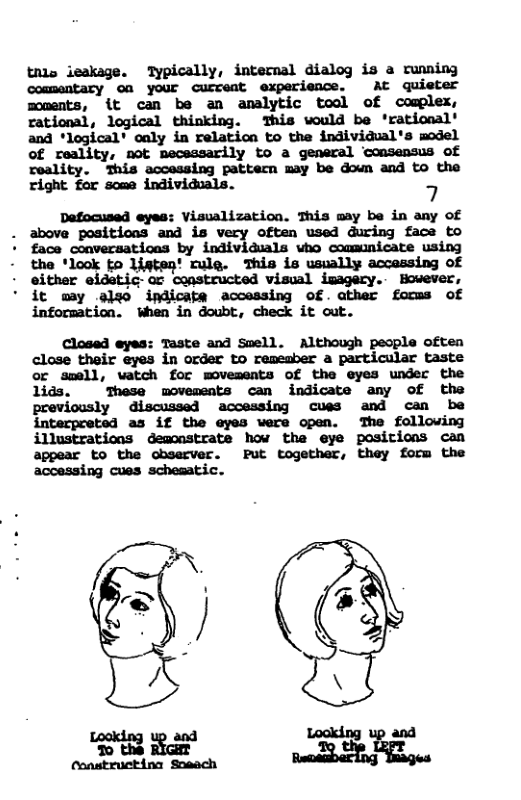
this pattern is usually associated with the process of
creating spoken lanjuage. Inthis position, the person
is "putting into words' vhat he vants to say next: L
|
}
f
{
|
E
!
be
1§§§
]
ihe
;
i
iz
H
|
3
g
{
3
i
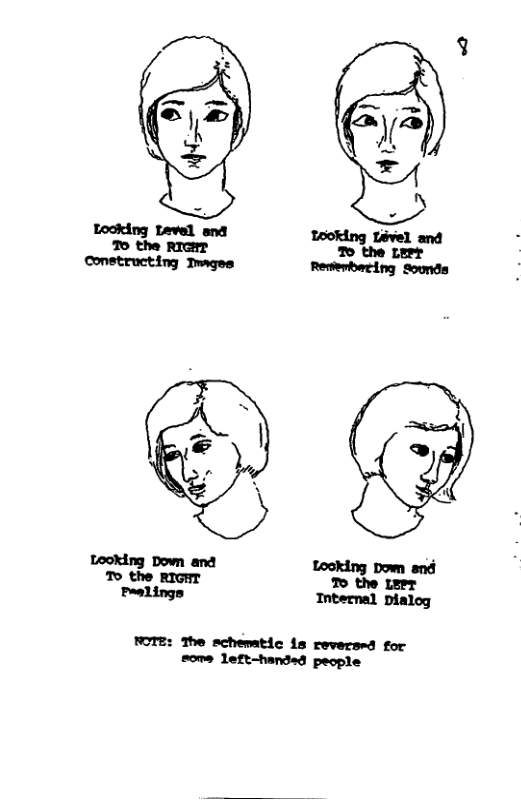
Iooking dovi emd to the LefE: Interrml dislog.
Usually associated with ‘deep thought,® these are the
vords and somnds riede intiAaFly EfatracGtimAhy Sthis
process. At timés thesé sounds ahd exclamatins mey
‘1éax' out vithout a pétson's belfg ware of it: 'Please
stop murbling to yourself' is an often heard résponse to
i e
: m Wmmummmm
Looking pown snd
0 the Leer
Internal pialog
ROTE: The schematic is reversed for
foms left-handsd pecple
Other Accessing Patterns
Jos ‘sess' this image, he becomes . it is
isportant to note that Joe is unavare of
z: process... ‘I doa’t know. I just'get the
If this is true, then it is not actually his vife's
looking at hia that ‘certain vay' that is upsetting
gy
i i
ullsi
i ww it
,.um m.m ..m. -m,' .,fixflmmm
FeFE
hiiidi m LT M L M
.iw..m” i mm M m FMW mmfi .flm
mmmmmm mxmx%mmm ,,m. 1 fhadjs mm
i, gl e
il gty
Uil mmmm il
mmm mmfifi m_ L
i il ¢ il
saiee. e guestions given nere are only examples. You
can be creative and generate questions of your ovn, but
Pay attention to the predicates you use. If they
presuppose a representational system which is different
from the one.you are testing, the person may be led into
the accessing pattern associated with that system. ,J
-+ 1. Comstructed Tesges. Ask a visual question about
the future, like, 'Mhat do you imegine I, this town,
that tree, vill look like ten years form now?' This
Wmmhmmhflq‘c(mng
he has not: yet experienced.
2. Eldetic Imges. Ask a visual question about the
past like, .'What color vas your first car?’ or about
specific information like, Row many windovs are thece on
the front of your house?' This calls to mind some
previously experienced image.
3. Comstructed Speech. Ak for a complex verbal
response like, 'What does it mean to be 'predisposed’?’
If you preface this question with the directions, 'just
think about vhat you would say without answering,® you
allow for the 'rehiearsal’ of speech.
4. Remesbered Sounds. Ask for auditory recall from
mmmw&n,afim'unxm-
like, 'What_was, the; first ’ma’i'm“'m. or
"What letter cords before 'p' in the 2t
5. Pealings. Ask-a question vhich presupposes the
System, especially derived from feelings
like, 'Bov did you feel on the before your last
bitthday?' or 'vhat was the fost exciting, scary, happy
expecience you ‘ever had?' Again, asking the person to
simply think 6f ‘the émperience .vithout verbally
responding sdy give you a better amalég response.
6. Themal Bilog. Often the most difficult to
detect, this cue is best observed as it naturally
om;mnymnnmhmbfimmdndm
othets. be
RS oy S R o TeSS, TR S he o
I
m _Mmmmmmmmm
wmmwm 5
il
fitiagese
WE.ME h
Preferred System and Hierarchy
movesents, shifts ‘in breathing
since it ‘is important
of systematic usa of
know what a perscn's
patterns ‘are - vhether dowa left or
fqc exasple - it is
the porsca‘s
ey ol
‘representational
. *'A8 in Part
of .the instructicas given are qaly
ifieetit
e
W‘Mmm mMMmq m
i
sopasomiaLare UL Wit oW De S0, USe your own
ideas in creating the instructions and questions that
vill -be most comatible with your normal way of
commmicating. s
Section I. Give the instructions before
wvith the three steps bel
wvords, and
wit
'h!-l‘er‘fllqlnl‘l-,glmkmm!fi-mfi;
and t
use of one of these patterns as you continue belov.
2Mbstract Wown. Say an abstract mowm - a
nominalization - 1ike ‘friendship’ or
" ,' then wait for the nonverbal
You have disrupted his expectations by saying a wocd
that doesn't make sense, and the confusica that
results from the surprise nonsense syllables creates
a mildly stressful situation in which he will most
moment: ago?*
The person’s response to the question will indicate
vhether he vas more alert: to the auditory portion of the
expecience of to the viswal portion. If he points out
the incongruity betveen vhat you said and what you did,
over anditory.
Say: 'Tell me what yon are avare.of as I do this.'
Do: As you say the.word 'this,’ with one hand gently
touch the person, vhile with the other hand ‘scribe an
arc' across the person's field of vision.
Again, this vill indicate vhere the person's
attention is dram. The person's response will let you
Jnow how to score.
Of course this hierarchy testing leaves out the
digital representational system. A ‘digital’ .will be
more likely to score auditory and visual over
Xinesthetic. However, a ‘digital’ will also tend to
score viswl over auditory, while an ‘avditory' will
The visual model provides us with a format for
j
seeing, understanding and utilizing consistent patterns
of observable befavior. Based in part on reseacch and
pragoatic applications of the Bandler-Grinder model,
interest or arousal. With food light, pupil response
can be seen from as far away as five feet or more.
Close cbservation of a person's eyes during the uttering
of key words or phrases can assist you in determining
his areas of concern and interest. As both the jade
dealers and the Arabs have realized; -this response
cannot be controlled, since it is governed by
sympathetic nervous systea. g 150 peovide
Eye scanning patterns or accessing cues peov;
information about how an individual is thinking.
Combined with breathing and postural shifts, they can
prove to be extremely useful ia assisting pecple
discover and change limiting and pain producing
behaviors. As in the example wvhere Joe creates
uncoafortable feelings from an unconscious eidetic image
these behaviors -usually oparate.outside a perscn's
avareness and coatrol.
E
g
understand how pecple systematically delete certain
aspects of experience from their awareness and what
those aspects of the environment are most likely to be.
with this information, you can help pecple alert
to situations in which they consistently stog themselves
from seeing, feeling “of: hearing input. As vas
shown in other experiments, deletion of portions of
experience from a porsoa’s model of tha world is
potentially harmful and limiting to a positive and
g.
techniques can be used at any time
of an interviev, therapy session or
verbal commmication is taking place.
thing to remember is to maintain
rapport. To suddenly turn to someone and
tell me the color of your first car?' may
effective than casually, during the course
A
|
1
it
-3
1
i
]
the time. Once you get used to
the concept and its uses, you will find that it is
unnecessary to go through the formal mapping
Many people will give you all the information
during the course of a normal conversation.
>= Seze Pauper’s Press Werks -<
* psycholegical Visibility ~ Cencepts thut apply te us each day.
Bov te tell if semeens is lying te. yeu:NLP
The 8Y Lavs of Rumer Spread
Twodle Newslotter
~> DIY and'pére by Salerne —<
How to use the lev 1 and weite yeur own law werk
Lav' Ferms
Criminal 1av Case Citator
Criminal Law Concepts
A Letter From Bome
wwv.freesslecne.com